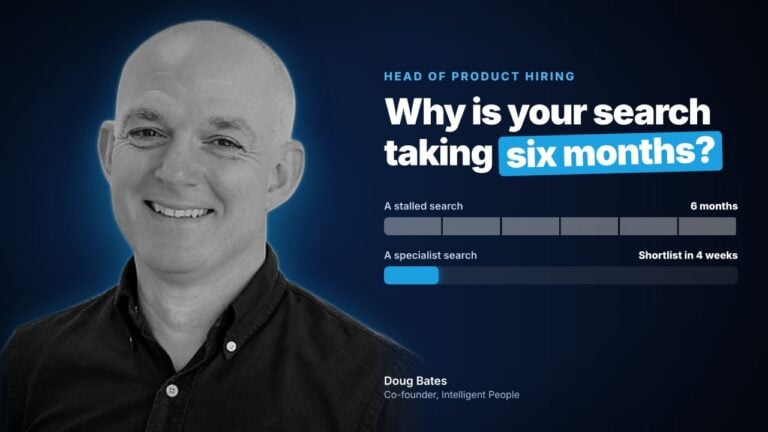
Written by Doug Bates, co-founder, Intelligent People
The short answer is, most senior product searches which drag their heels typically come down to five fixable things: an unclear brief, you’re hiring at the wrong level, a salary below the market rate, a slow or overly complex interview process, a recruiter who is starting from scratch. Fix those and a strong shortlist should take weeks, not months. At Intelligent People we typically deliver a quality shortlist within four weeks of being briefed, and sometimes less.
I speak to founders and CEOs most weeks whose Head of Product search has dragged on for months. The advert has been up since spring, a few people have been interviewed, nobody quite fits, and the product roadmap is waiting. In my experience it’s rarely bad luck. It’s usually one of the five things I’ve mentioned.
Is the brief clear about what kind of product leader you need?
“Head of Product” covers very different jobs. Do you need someone to set product strategy, or someone to get the current roadmap delivered? B2B or B2C experience? Growth, platform or a new product from scratch? If the brief tries to cover everything, every candidate will look like they’re missing something.
Are you hiring at the right level?
A surprising number of stalled searches are really a level problem. The company is advertising for a Head of Product but describing a CPO, or the other way round. Candidates notice, and the strong ones don’t apply for a role that doesn’t add up.
Is your salary where the market is?
If you’re benchmarking against what you paid two years ago, you’re probably behind. Senior product people know what they’re worth, and they’re usually approached by more than one company at a time.
We’ve created a Product Management salary guide which we review and update regularly, the link is below.
Is your interview process losing people?
Long and overly complex processes lose the best candidates first, because they have other options. Too many stages, slow feedback and long gaps between interviews all give a strong candidate time to accept something else.
Three-to-four interviews would be the norm for a scaling organisation, done over a four-week cycle; the timeframe is more important than the number of stages.
Are you starting from scratch?
This is the big one. Senior product talent is used to being headhunted, so they don’t need to look at job ads and are likely to already be speaking with a specialist headhunter who can present them with the briefs that they are interested in The top, upper-quartile people have often been headhunted throughout their careers and when they do move, it’s often with people they’ve worked with before, who’ve gone on to found new companies and brought them along, or they set up on their own.
So, if your search is an advert or a recruiter who doesn’t have a network of product talent you’re only seeing the small slice of the market that happens to be looking this month.
Put simply, the best Heads of Product aren’t reading job ads. They’re being approached.
What does a specialist search do differently?
It starts with the brief and the level, so the search is aimed at the right people from day one. Then it goes to where the best people actually are. For us that means networks most recruiters don’t have, including our product mentorship platform and CPO Track, the private network for product leaders that we sponsor, plus 24 years of hiring product roles.
It’s why we can typically deliver a shortlist within four weeks of being briefed.
A good example is a client who needed a VP Product for their education marketplace, they had run adverts and worked with generic tech recruiters for six months and still had the role open; within three weeks of the brief, we had presented a shortlist of candidates, allowing them to make a successful hire within eight weeks of retaining us.
If your Head of Product or VP Product search has stalled, book a call with me, even a 15-minute conversation about the brief and level usually shows where it’s getting stuck.