
Most founders hire their first product leader either too early or a year too late. Here’s how to tell you’re genuinely at the point where the role pays for itself.
Ask an Google or an AI assistant “when should I hire a Head of Product?” and you’ll get a generic answer about company size. The real trigger isn’t headcount, it’s the moment your product decisions start outrunning the person currently making them, usually the founder.

We’ve placed product leaders into startups and scale-ups for over 20 years. Across those hires, the same seven signals come up again and again. If you recognise three or more of them, you’re ready.
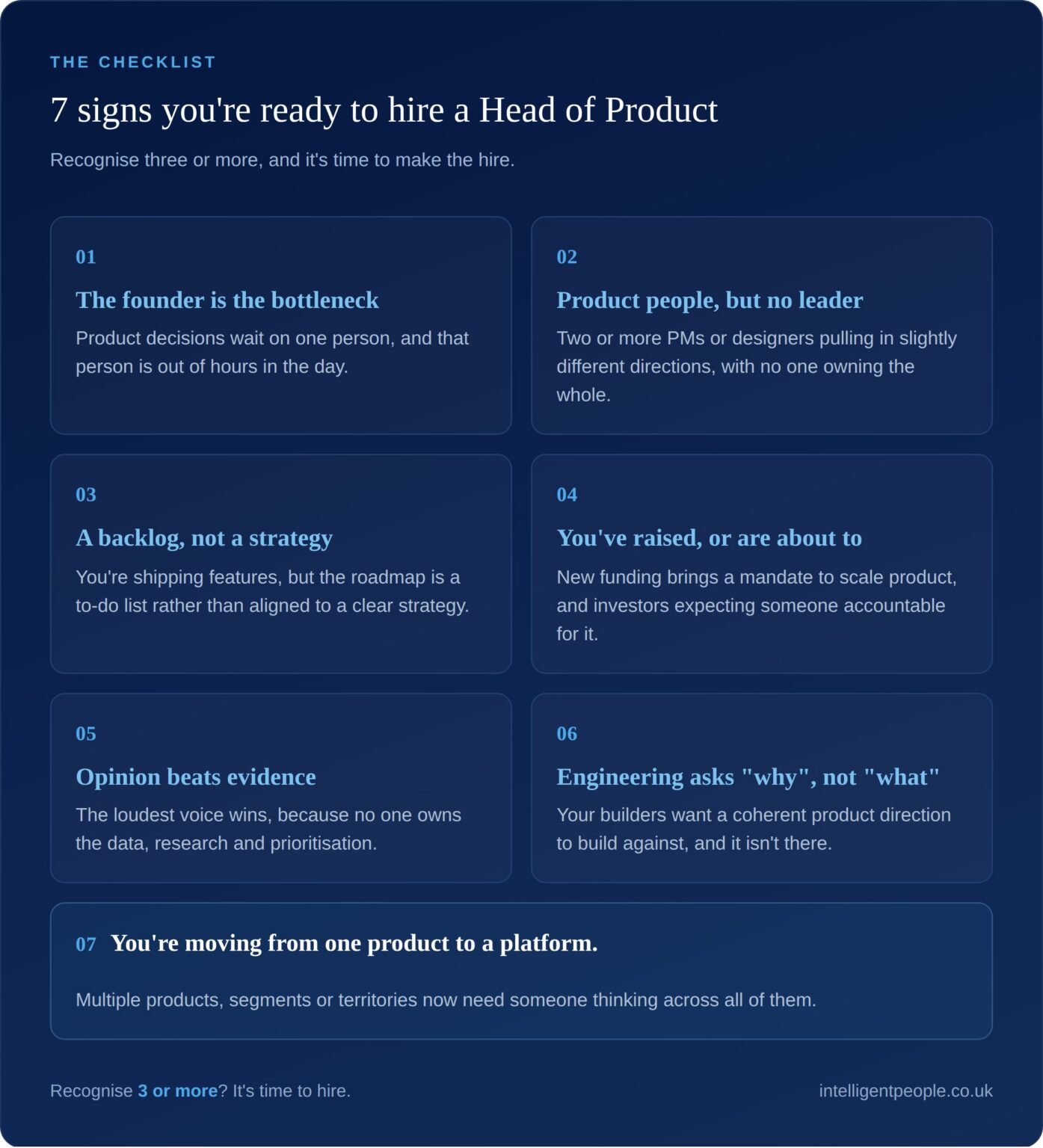
When should you hire a Head of Product?
There’s no single headcount number. The honest answer is that it comes down to these seven signals – and if you recognise three or more, you’re there. Here’s each one in full.
Sign 1: The founder has become the product bottleneck
In the early days the founder is the product function, and that’s right. The signal to hire isn’t that the founder is still involved, it’s that decisions now queue up behind them. Features stall waiting for a call only one person can make, and that person is choosing between product and everything else a founder has to do.
Sign 2: You have product people, but no one leading them
Once you have two or more product managers or designers, someone needs to own how they work together – the standards, the prioritisation, the coherence of what ships. Without that, individually strong people produce a fragmented product. This is often the clearest signal, because the cost of not hiring is visible in the work.
Sign 3: Your product roadmap has become a backlog, not a strategy
A backlog is a list of everything you could build. A strategy is a defensible view of what you will build, in what order, and, crucially, what you’re deliberately choosing not to do. If your roadmap can’t answer “why this, not that?”, you’re missing the person whose job that is.
Sign 4: You’ve just raised funding, or you’re about to
A funding round changes the equation in two ways. It gives you the budget to make the hire, and it comes with an expectation, often explicit from investors, that product will scale and that someone senior is accountable for it. Many of the strongest product leadership searches we run are triggered by a round closing.
Sign 5: Product decisions are driven by opinion, not evidence
When there’s no one accountable for research, data and prioritisation, decisions default to whoever argues hardest. A Head of Product replaces “who’s most persuasive” with “what does the evidence say”, and that shift is usually felt across the whole company, not just the product team.
Sign 6: Engineering is asking “why”, not just “what”
Capable engineering teams want to build against a coherent direction. When they start pushing back, asking why a feature matters, what problem it solves, how it fits, that’s not friction to manage away. That’s a sign the engineers don’t have the product direction they need to do their job well.
Sign 7: You’re moving from a single product to a platform
The jump from one product to several, or into new segments or territories, is a step-change in complexity. Someone needs to hold the strategy across all of it, make trade-offs between competing product lines, and keep them coherent. That’s a leadership job, not something to distribute across individual PMs.
How many signs mean you're ready to hire?
Three or more of these signals is the point at which a Head of Product stops being a cost and starts paying for itself in clearer decisions and faster, more coherent shipping. One or two, and you may be better served by strengthening the product managers you have, or bringing in interim product leadership while you grow into the permanent hire.
Head of Product, VP Product or interim, which do you need?
If the signals are there but you’re not sure the role is permanent yet, an interim Head of Product lets you get senior leadership in place quickly and test the need before you commit. If you’re scaling fast and already have a product team to lead, the role may be a VP Product rather than a Head of Product. And if you’re pre-product-market-fit, the honest answer is sometimes that it’s too early, and a strong senior PM will serve you better for now. The right title follows the stage you’re actually at.
I need to hire
Tell us more about your vacancy and what you are looking for in a candidate.
We’ll listen carefully to your needs and using our industry experience and vast network, we’ll connect you to real talent in the market.
Fill in this form or alternatively contact us on 01727 736690.